food4future at Leibniz's 20th Anniversary in Brussels
Algae Reactor and Mixed Reality
02.09.2026
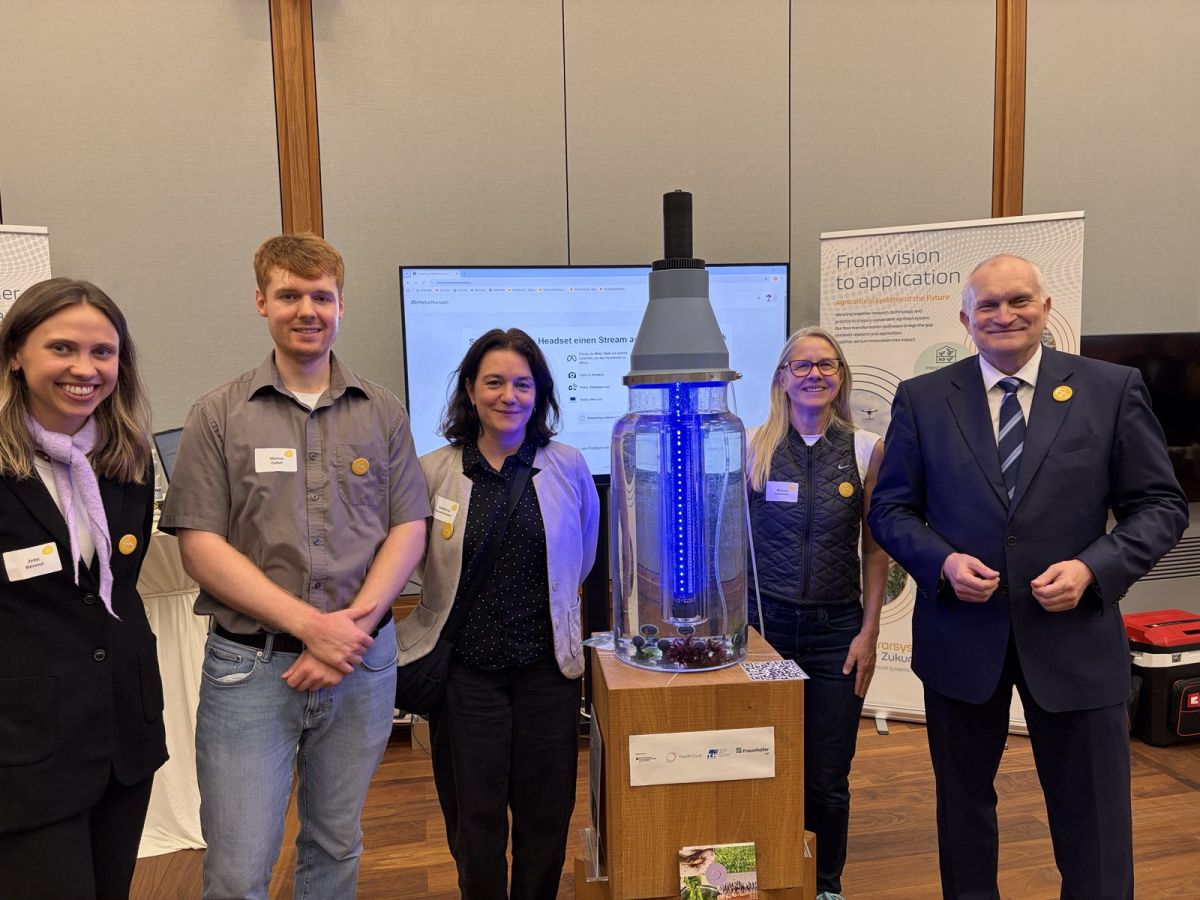
On September 1, 2026, the Leibniz Association celebrated the 20th anniversary of its European Office in Brussels. Representatives from the fields of science, politics, and business gathered at the anniversary event “Celebrating 20 Years of Leibniz in Brussels” held at the Baden-Württemberg State Representation. food4future was also in attendance and presented two insights into research on future agricultural and food systems: an algae reactor and the mixed-reality application “Food Visions.”
The evening was opened by Petra Olschowski, Minister of Science, Research, and the Arts for Baden-Württemberg, and Christoph M. Schmidt, President of the Leibniz Association. In their opening remarks, both made clear what the evening was fundamentally about: finding the path from theory to practice, asserting Europe’s position in global competition with the U.S. and China, and keeping the continent at the forefront of science in the future, while maintaining a wise balance between openness and security in research. Schmidt also emphasized how important it is that research findings are actually utilized and translated into technologies, rather than ultimately being applied only abroad, and advocated for greater exchange between European and national research funding agencies.
In the keynote address by Irene Bertschek, Chair of the Expert Commission on Research and Innovation (EFI), and the subsequent panel discussion “Theoria cum praxi: Competitiveness, Sovereignty, and Society in Transition”, featuring Gerhard Kahmen (IHP), Barbara Sturm (Vice President of the Leibniz Association), Member of the European Parliament Christian Ehler, and Claire Skentelbery (EuropaBio), moderated by Eric Miller, this very tension was explored in depth: How, specifically, does research strengthen Europe’s future viability and cohesion? The reception that followed, featuring an exhibition of selected Leibniz research activities, accompanied by the ABC Trio, then provided the setting in which food4future could present its answers.
Algae Production as a Building Block of Future Food Systems
At the exhibition area food4future, a flagship project of the IGZ, displayed an algae reactor that demonstrated how macroalgae can be cultivated under controlled conditions. This brought a central research question of the project into focus: How can alternative food resources be produced in the future in a way that conserves resources and is as independent as possible from traditional agricultural land?
Algae are considered a promising resource in this context. Their cultivation does not rely on fertile farmland and can open up new possibilities for climate-adapted and urban production systems. The reactor on display clearly illustrated the biological and technical fundamentals of cultivation and provided a concrete starting point for discussion about potential, challenges, and future applications.
Exploring Possible Futures of Food with “Food Visions”
How will we feed ourselves in a possible future? Local cultivation in urban areas, alternative organisms, and community-based food systems are the answers presented by the immersive application “Food Visions” as a science communication format. Visitors engage with the algae reactor in the real world and explore new information and future scenarios in virtual reality.
“Food Visions” thus translates complex scientific questions into a format that invites exploration and discussion. Research is not merely explained but can be directly experienced as a possible future.
A special moment: Christoph M. Schmidt, President of the Leibniz Association, also put on the VR headset and explored the future scenarios of “Food Visions” for himself, a wonderful sign of how even at the highest levels, there is great curiosity about new formats of science communication.
Integrating Research and Science Communication
With the algae reactor and “Food Visions,” food4future brought two different approaches to the future of food to Brussels: While the reactor showcased concrete research into alternative food resources, the mixed-reality application offered a glimpse into possible future agricultural and food systems.
The anniversary event thus provided a fitting setting to place food4future’s research approaches within a European context and directly tied into the evening’s themes: the transition from theory to practice, the contribution of research to Europe’s competitiveness, and the question of how scientific findings actually make an impact.
food4future coordinator Prof. Dr. Schreiner summed up just how successful this can be: “With food4future, we strike the right balance between research, application, and food security. Using immersive technologies, we’ve made a true deep dive into our research possible.”
It was particularly gratifying to see that evening just how much curiosity the booth sparked, from interested questions from the audience all the way up to the president of the Leibniz Association himself. It became clear that new technologies like mixed reality can not only explain complex research but also bring it to life and that is exactly what is needed to truly kickstart the conversation about the food of tomorrow.
Participation in the anniversary event was made possible by the Leibniz Institute for Horticultural Sciences (IGZ), which represented food4future as one of the participating Leibniz Institutes.