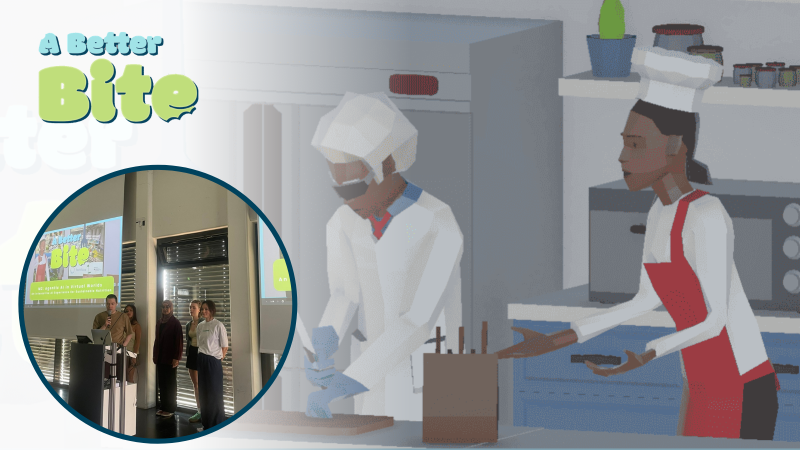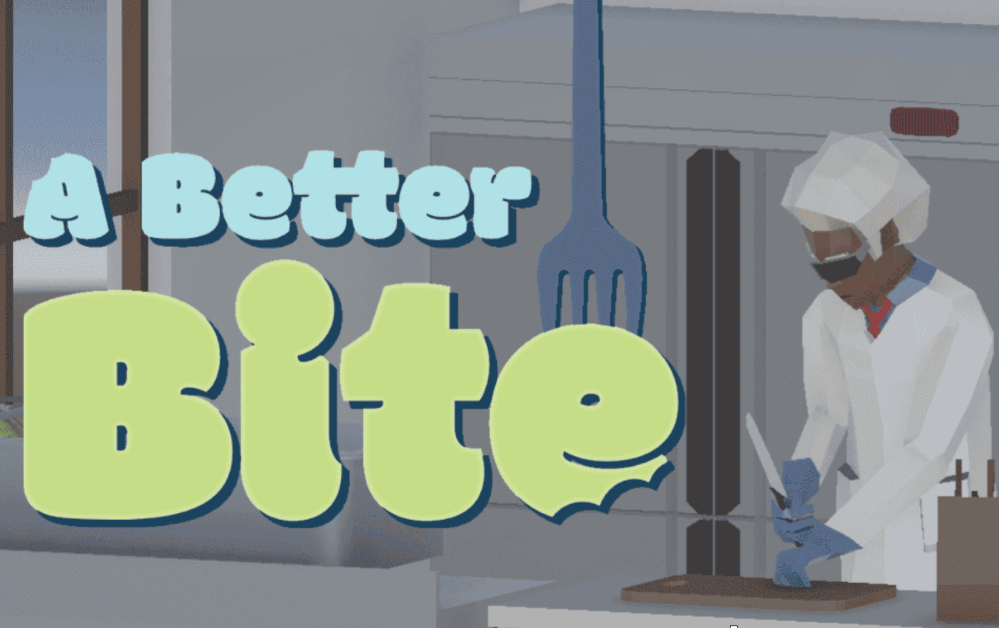
“A Better Bite” invites users to discover sustainable ingredients and recipes alongside an AI-powered virtual chef in an interactive 3D kitchen. (Photo: Students, HTW)
A Better Bite brings research on the future of food to life in a playful way through a virtual kitchen. In the interactive 3D environment, users meet a smart virtual chef with whom they can prepare dishes, discover new ingredients, and discuss sustainable eating.
The project begins with the question of how novel foods, such as algae, insects, or halophytes, can be presented in a way that is easy to understand and accessible. Instead of merely presenting information passively, A Better Bite relies on open, playful interaction: Users navigate through a virtual kitchen, select ingredients, try out recipes, and can ask the AI assistant questions or assign it tasks. In this way, scientific content is directly linked to concrete actions and everyday situations.
One unique feature is the use of what’s known as embodied AI. The virtual assistant isn’t just a voice or a chat window, it’s part of the three-dimensional environment. It knows the kitchen, the available ingredients, and the tools, and can guide users through the cooking process. Users can communicate with it via voice commands, ask questions about ingredients, or delegate individual steps to it. Virtual guests can also interact with the AI assistant, giving rise to a variety of conversational scenarios.
The system’s knowledge base links recipes with scientific information from food4future. Using Retrieval-Augmented Generation (RAG), the AI can access stored research content and incorporate it into the conversation in a way that is appropriate for the situation at hand. In this way, the project is also exploring how generative AI and virtual worlds can be used for new forms of science communication.
“A Better Bite” was developed as a master's thesis project at HTW Berlin in the field of “Agentic AI in Virtual Worlds.” The prototype combines game design, 3D development, and artificial intelligence, and serves as an example of how research on sustainable food can be translated into an interactive learning and experiential environment.
Project management
Jonas Ehrhardt
Marino Gabel
Participants
Zaynab
Ekaterina
Konstantin
Nele
Elisabeth
Project Context
food4future in collaboration with HTW Berlin